
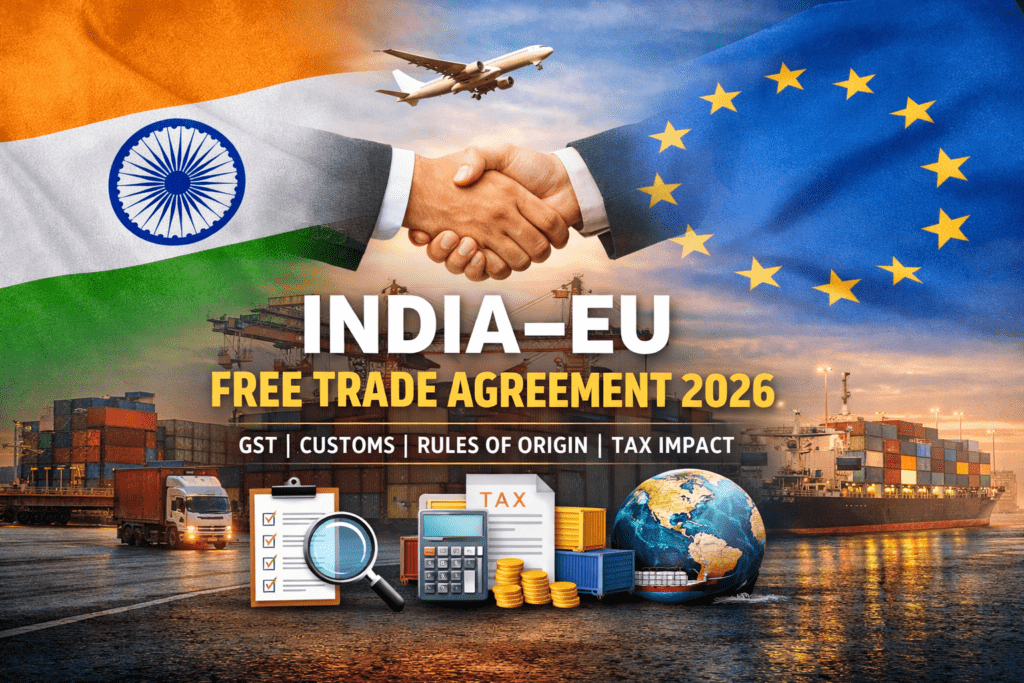
Introduction: Why the India–EU Flogan is a Turning Point for Indian Industry
The conclusion of the India–European Union Free Trade Agreement (FTA) in January 2026 represents the most transformative trade reform for Indian exporters and importers since India’s major Asia-Pacific trade arrangements.
Covering economies representing nearly one-fourth of global GDP, this agreement will progressively reduce tariffs, liberalise services, encourage foreign investment, and tighten regulatory coordination.
For Indian enterprises — particularly MSMEs, manufacturers, EPC contractors, IT firms, pharmaceutical exporters and agri-processors — the FTA is not just an opportunity; it is a compliance-intensive restructuring event.
This article explains — from a Chartered Accountant’s lens — exactly:
✔ How customs duties will change
✔ How GST cash flows are affected
✔ What Rules of Origin require
✔ How transfer pricing must be revisited
✔ What exporters should do immediately
✔ Where litigation risk lies
📊 What Is the India–EU Free Trade Agreement?
The India–EU FTA is a comprehensive trade and investment treaty negotiated over two decades and finalised in 2026.
It provides for:
-
Progressive elimination of customs duties on thousands of tariff lines
-
Preferential access to EU and Indian markets
-
Services liberalisation
-
Investment protection frameworks
-
Sustainability and carbon-compliance mechanisms
-
Regulatory recognition and product standards
-
Digital trade cooperation
Implementation will be phased over multiple years through notifications under the Customs Act, 1962 and DGFT procedures.
🚀 Sectors Poised to Benefit the Most
Indian Exporters:
-
Pharmaceuticals & APIs
-
Textiles, garments & leather
-
Engineering goods
-
Auto components
-
IT & business services
-
Processed foods
-
Specialty chemicals
EU Imports into India:
-
Industrial machinery
-
Renewable energy equipment
-
Luxury automobiles
-
Medical devices
-
Precision instruments
💡 Customs Duty Impact: Core Area for Strategic Planning
✔ Tariff Reductions = Price Advantage
Preferential tariff rates will replace MFN duties for qualifying goods. Businesses must recalculate:
-
CIF value
-
Basic Customs Duty
-
Social Welfare Surcharge
-
IGST on imports
-
Cess
✔ Rules of Origin = Gatekeeper of Benefits
FTA benefits apply only when:
-
Minimum value addition is achieved
-
Change in tariff classification satisfied
-
Process rules complied
-
Preferential Certificate of Origin issued
Non-compliance leads to:
❌ Demand notices
❌ Interest under Customs Act
❌ Penalties
❌ Seizure/confiscation
❌ Suspension of FTA benefit
🧾 GST Implications of the India–EU Trade Deal
🔵 Imports:
Reduction in Basic Customs Duty reduces IGST base → improves working capital.
🔵 Exports:
-
Zero-rated supplies continue
-
LUT vs refund strategy becomes important
-
Higher export volumes require stronger GST documentation
-
Reconciliation between GSTR-1, shipping bills & ICEGATE data is critical
🔵 Supply Chain Re-engineering:
Tariff arbitrage may change procurement locations — triggering:
-
New GST registrations
-
Branch transfers
-
Place of supply changes
-
Job-work structures
🌍 International Tax & Transfer Pricing Re-alignment
Expect heavy activity in:
-
Transfer pricing benchmarking
-
Permanent Establishment analysis
-
Royalty/service fee structures
-
Inter-company distribution models
-
DTAA planning
-
Withholding tax exposure
Multinationals restructuring operations to leverage the FTA must update:
✔ Master File / Local File
✔ Inter-company agreements
✔ DEMPE analysis for IP
✔ APA feasibility
⚠️ High-Risk Compliance Areas Businesses Must Control
| Area | Risk | Solution |
|---|---|---|
| Rules of Origin | Denial of duty benefit | Supplier declarations + audit |
| Valuation | Related-party disputes | TP study alignment |
| GST Refunds | Cash-flow blockage | Documentation matrix |
| ESG/CBAM | Market access denial | Carbon audit |
| Product Standards | Shipment rejection | Certification pre-export |
📋 India–EU FTA Readiness Checklist (Board-Level)
✅ HS code mapping
✅ Landed-cost modelling
✅ Origin matrix by product
✅ Vendor restructuring
✅ ERP flagging for FTA shipments
✅ Contract clause updates
✅ TP study refresh
✅ GST reconciliation automation
✅ ESG reporting
✅ Customs audit preparedness
⏳ When Will It Apply?
The agreement is undergoing ratification and legal scrubbing. Tariff notifications and operational procedures will follow in phases — likely over 2026–27.
Businesses that prepare before notification typically capture first-mover advantage.
🎯 Why Businesses in Indore & MP Should Pay Special Attention
Indore and Madhya Pradesh have strong presence in:
-
Engineering & fabrication
-
Pharmaceuticals
-
Agri-processing
-
Textiles
-
Auto ancillaries
-
Chemical manufacturing
These sectors are prime beneficiaries of EU tariff reductions — provided compliance systems are robust.
Local MSMEs must upgrade export readiness to meet EU standards.
🔍 FAQs – India–EU FTA
Q1. Will GST rates change?
No — but import IGST base will reduce due to lower customs duty.
Q2. Is Certificate of Origin compulsory?
Yes — without it, preferential rates cannot be claimed.
Q3. Should exporters restructure supply chains?
Possibly — after analysing Rules of Origin and tariff schedules.
Q4. Will EU carbon rules apply?
Yes — CBAM will impact exporters in steel, aluminium, cement, fertiliser and energy-intensive sectors.
📞 Conclusion: Opportunity + Compliance = Competitive Advantage
The India–EU FTA is not merely a trade treaty — it is a strategic reset of Indian global commerce.
Businesses that integrate:
✔ Tax planning
✔ Customs optimisation
✔ GST compliance
✔ Transfer pricing discipline
✔ ESG readiness
will dominate EU markets.
At Pankaj Agrawal & Associates, Chartered Accountants, Indore, we assist exporters and importers with:
🔹 FTA impact studies
🔹 Customs advisory
🔹 GST structuring
🔹 Transfer pricing
🔹 Export compliance systems
🔹 EU regulatory readiness
📍 Office: 88 Jawahar Nagar, Near Rajendra Nagar, Indore
📞 Mobile: 9091351333
📧 Email: pankajagrawal0116@gmail.com