
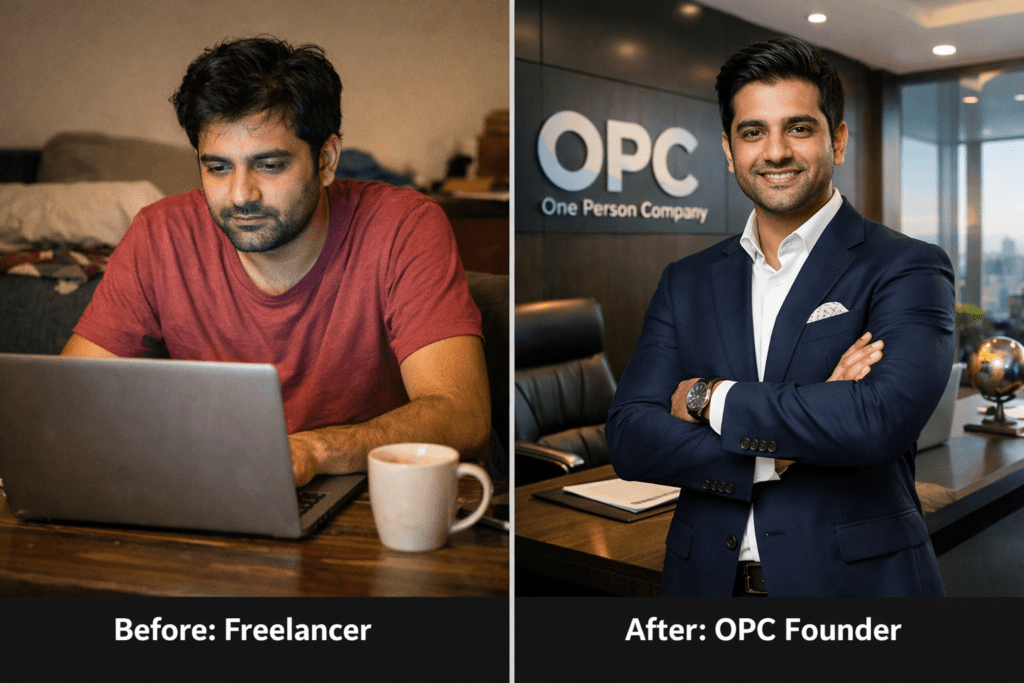
In 2026, the Indian “Gig Economy” has matured into a “Consultant Economy.” With top-tier tech professionals frequently crossing the ₹30 Lakh to ₹75 Lakh annual income mark, the tax man is taking a larger bite than ever.
If you are a high-earning freelancer, staying as an “Individual/Proprietor” under the Income Tax Act 2025 slabs might be your most expensive mistake. Here is why transitioning to a One Person Company (OPC) is the strategic move for AY 2026-27.
1. The Tax Bracket Trap (Individual vs. OPC)
Under the New Tax Regime for AY 2026-27, once your taxable income crosses ₹24 Lakh, you hit the 30% tax bracket.
Conversely, a “Small Company” (which most OPCs qualify as) enjoys a base corporate tax rate of 22% (plus surcharge and cess) under Section 115BAA.
The Mathematical Shift:
- As an Individual: You pay tax on your entire net profit. After ₹24 Lakh, every extra ₹100 you earn, the government takes ₹30.
- As an OPC: You can pay yourself a Salary. This salary is a deductible expense for the company. You only pay personal tax on the salary you draw, while the remaining profit stays in the company, taxed at the lower corporate rate, ready to be reinvested in equipment, software, or office space.
2. The 2026 “Business Expense” Advantage
In 2026, the Income Tax Department’s AI-driven scrutiny of “Presumptive Taxation” (Sec 44ADA) has tightened. High-earning freelancers are often asked to prove their 50% expense ratio.
An OPC provides a cleaner “Expense Shield”:
- Tech Upgrades: 100% deduction on high-end servers, AI workstations, and software subscriptions.
- Home Office: Deduct a portion of your rent, electricity, and high-speed internet as legitimate corporate expenses.
- Travel & Upskilling: International tech conferences and certifications are fully deductible business costs.
3. Limited Liability: Protecting Your Personal Assets
In 2026, software contracts are becoming more complex, often involving strict Indemnity Clauses for data breaches or project delays.
- Freelancer: Your personal house, car, and savings are at risk if a client sues you.
- OPC: Your liability is limited to the capital of the company. It creates a “Corporate Veil” that protects your personal wealth.
4. The MCA V4 Portal: Incorporation in 24 Hours
Gone are the days of month-long waiting periods. With the MCA V4 Portal’s AI-driven “STP” (Straight Through Processing) launched in early 2026, an OPC can be incorporated in as little as 24 to 48 hours.
As your CA, we handle the Spice+ filing, e-MOA/AOA, and instant PAN/TAN generation, ensuring you are “Business Ready” within a week.
5. Decision Matrix: When should you switch?
| Factor | Stay as Freelancer | Switch to OPC |
|---|---|---|
| Annual Income | Below ₹20 Lakh | Above ₹25 Lakh |
| Growth Plan | Solo work only | Hiring or Scaling |
| Tax Rate | Up to 30% | ~25.17% (Effective Corporate) |
| Brand Image | Individual Talent | Corporate Entity |
FAQs for Tech Professionals
Q: Is it hard to take money out of an OPC?
A: Not at all. You draw a monthly salary (which is a business expense). Any surplus can stay in the company for future growth or be paid out as dividends.
A: Not at all. You draw a monthly salary (which is a business expense). Any surplus can stay in the company for future growth or be paid out as dividends.
Q: Do I need a second Director for an OPC?
A: No. You are the sole Director and Shareholder. You only need to nominate a “Nominee Director” (usually a family member) who only takes over in the event of your absence.
A: No. You are the sole Director and Shareholder. You only need to nominate a “Nominee Director” (usually a family member) who only takes over in the event of your absence.
Q: Can I switch from 44ADA (Presumptive) to OPC?
A: Yes. If your income has grown to the point where 50% profit margin feels “artificial” or you are paying too much tax, 2026 is the perfect time to restructure.
A: Yes. If your income has grown to the point where 50% profit margin feels “artificial” or you are paying too much tax, 2026 is the perfect time to restructure.
Final Verdict
If your 2026 projections show you crossing the ₹25 Lakh mark, the tax savings alone will pay for the OPC’s compliance costs in the first 6 months.
Stop being a freelancer. Start being a Founder.
Call us:
CA Pankaj Agrawal